


The World's Longest Flight Has No Economy Class. But Can You Handle 19 Hours?

Updated: Aug 12
There are not many occasions in life when you willingly lock yourself inside a pressurized metal tube and stay there for almost an entire day.
Flying the world’s longest nonstop flight had been sitting on my aviation bucket list for years. When a trip to Singapore finally came up, the opportunity was too good to pass up: I booked Singapore Airlines Flight SQ23, nonstop from my home city of New York to Singapore.

For aviation geeks, this route comes with a whole parade of buzzwords: the world’s longest scheduled commercial flight, no economy class, and a specially configured Airbus A350-900ULR designed to stay airborne for nearly 19 hours.
I flew in Premium Economy—the lowest cabin available on Singapore Airlines’ A350 ULR. I wanted to answer a fairly simple question: for someone who does not want to shell out for Business Class but still has to spend nearly an entire day in the sky, is this flight genuinely manageable, or is it just an extremely expensive form of torture?
Before the Flight: Preparing to Lose an Entire Day
The first difference between an ultra-long-haul flight and a regular one begins before you even reach the airport.
On a short flight, my mindset is usually straightforward: grit your teeth, kill a few hours, and you will be there before you know it. Nineteen hours is a different ball game. You are not simply taking a flight—you are temporarily moving into an aircraft.

Singapore Airlines operates from Terminal 4 at New York JFK, Delta’s hub, rather than Terminal 1, where many Star Alliance carriers are based.
The check-in area was located toward the left side of the terminal, with plenty of self-service kiosks and four priority counters. Staff actively directed Economy and Premium Economy passengers toward the machines, and the overall process moved efficiently. As a Star Alliance Gold member, I was able to use one of the priority counters and finish check-in within a few minutes.
The agent told me that eligible status passengers could use the Air India lounge. However, several online guides and traveler reports suggested that Star Alliance Gold passengers could also access the Capital One Lounge with their boarding passes, so that was where I headed.

The lounge is easy to find between the A and B gate areas, near the Centurion Lounge, Chase Sapphire Lounge, and Delta One Lounge. I had visited the Chase and Amex lounges several times before, but this was my first experience with Capital One.

My immediate impression was that the design felt closer to Chase than Amex: warm wood finishes, marble counters, photogenic bubble-shaped lighting, and a wide variety of seating.
There were proper dining tables, high-top workstations, and comfortable sofas for anyone who simply wanted to zone out before boarding.

The food was the real highlight—and, in my opinion, where Capital One outperformed both Chase and Amex.


Alongside five or six hot dishes and a salad bar, the lounge offered several made-to-order small plates. Naturally, I treated the menu like a personal challenge and ordered almost everything that caught my eye: Brussels sprouts, a short-rib slider, asparagus and egg salad, roasted squash and pear soup, crispy cheese bread, and raspberry mousse for dessert.
The two standouts were the short-rib slider and the roasted squash and pear soup. The slider used meat from Pat LaFrieda, a New Jersey-based supplier whose beef is also used by Shake Shack. That is a pretty solid vote of confidence.


Boarding: When Everyone Is Priority, Nobody Is Priority
Boarding was one of the more amusing parts of the experience.
The A350-900ULR carries just 161 passengers: 67 in Business Class and 94 in Premium Economy. There is no Economy cabin at all.

Because the aircraft has such a large Business Class section, even the Business Class boarding line became surprisingly long. Star Alliance Gold members and Premium Economy passengers were placed in the same boarding group, creating one of those situations where practically everyone was labeled “priority,” which meant no one felt particularly prioritized.
Still, the process moved faster than expected. With only 161 seats onboard, the entire aircraft carries fewer people than some single-aisle jets.

First Impressions: Surprisingly Relaxed
The first word that came to mind after sitting down was spacious.
Because of the aircraft’s low-density configuration, Premium Economy passengers receive 38 inches of seat pitch and a generous 19-inch-wide seat. That puts it in the same league as many domestic First Class seats in the United States.

For comparison, American Airlines’ domestic First Class seat on the Boeing 737 MAX offers roughly 37 inches of pitch and a width of around 20 inches. Singapore Airlines Premium Economy is not far behind.

At 6'-01'' (185 cm) tall, I could stretch my legs comfortably. With the seat reclined and my feet resting on the leg support, my body felt properly supported rather than folded into an awkward human pretzel.
The cabin uses a 2-4-2 layout, which means even a window passenger only has to step past one person to reach the aisle. That might sound minor, but on a 19-hour flight it is a big deal. You will need to use the restroom, stretch, refill your water, and walk around the cabin. Being trapped behind two sleeping strangers would get old very quickly.
The seat also had plenty of practical details:
A cupholder at the front of the armrest
A large storage pocket beside the seat
A dedicated bottle holder with two bottles of water already provided
A coat hook beside the screen
An adjustable reading light
Enough space for my laptop, passport, power bank, and other essentials

Overhead-bin space was equally generous. I boarded relatively late, yet still found room for both my suitcase and camera bag. With so few passengers spread across a wide-body aircraft, the usual battle for overhead space simply did not happen.
Before departure, the crew handed out proper hot towels—not thin disposable wipes, but actual cotton towels.
It is a small tradition, but an effective one. Hot towels cost relatively little while instantly creating a sense of occasion. Singapore Airlines understands how to turn tiny details into memorable parts of its brand experience. Other airlines should take notes.

Wi-Fi: Free, but Barely Functional
Wi-Fi was complimentary throughout the flight, but the performance left a lot to be desired.
Before Singapore Airlines completes its broader transition toward Starlink, the current system on this aircraft is provided by Panasonic. During the first half of the journey, it was just about usable. Latency hovered around 600 milliseconds, but I could at least send messages.
Once we reached the latter portion of the flight, the connection essentially gave up on life. It stopped working properly and remained unreliable until we landed in Singapore.

On a 19-hour journey, that is a genuine weak point. Many passengers will want to message family, check social media, or simply feel connected to the outside world. Free Wi-Fi sounds excellent on paper, but “free” does not mean much when it barely works.
The good news is that inflight connectivity is improving rapidly across the industry. As Starlink becomes more widely available, I expect the onboard internet experience to improve dramatically. This is one area I would happily return to test again in the future.
A practical reminder: Singapore Airlines KrisFlyer members can generally receive complimentary Wi-Fi regardless of cabin, so make sure your membership number is linked to the booking before departure.
KrisWorld: More Entertainment Than You Could Possibly Finish
What the Panasonic Wi-Fi system lacked, the Panasonic-powered KrisWorld entertainment system made up for.
Premium Economy passengers receive a 13.3-inch screen, and both the resolution and display size rank among the best in the cabin category.
The content library is enormous. The “Hollywood Classics” category alone contained 154 films spread across page after page. There was also a deep selection of Chinese-language films, television series, music, and international entertainment.

The biggest surprise was Live TV.
Live television is no longer rare on modern aircraft, but Singapore Airlines offered an unusually broad selection of channels. Somewhere over Asia, I managed to watch a live Premier League match between Arsenal and Burnley.

There is something wonderfully surreal about crossing half the planet while watching a football match unfold in real time below.
During the hours I was awake, I watched two movies and never came close to running out of options. On a flight this long, the entertainment library can make the difference between enduring the journey and genuinely enjoying it.
That said, I still recommend bringing an iPad or downloading your own content. No matter how impressive an inflight system looks, having a backup is never a bad idea.
Dinner: Plenty of Food, Not Enough Moisture
I pre-ordered braised beef with mashed potatoes through Singapore Airlines’ Book the Cook service.
The meal was acceptable but landed firmly in the middle of the pack. The beef had been cooked well done and became fairly dry after reheating. The salad leaves also lacked moisture, while the dessert was a stereotypically sweet American-style cake. Even the bread and crackers were served cold and dry.

The entire tray felt as though it needed a drink to rescue it.
Because I had pre-ordered my meal, it was delivered before the regular service. That turned out to be fortunate, because the standard meal service moved slowly. Roughly one hour and 40 minutes passed between takeoff and the first proper round of food and drinks. During that time, there was no separate beverage cart making its way through the cabin.
The same slow pace appeared again during breakfast.
Presentation, however, was a strong point. The meal came with metal cutlery and proper tableware, which immediately made it feel more polished than a standard Economy meal. Metal cutlery should arguably be the bare minimum in Premium Economy—some flag carriers may wish to take note.

The drinks list was also more serious than expected. Champagne came from Charles de Cazanove, the white wine was a Craggy Range Sauvignon Blanc from New Zealand, and the red was a St Hallett Shiraz from Australia’s Barossa Valley.
I also ordered a Singapore Sling. Drinking the city’s signature cocktail while flying directly to Singapore is exactly the kind of aviation ritual that is worth doing at least once. The drink followed the classic recipe dating back to 1915, although the cherry liqueur came through a little aggressively.
Was it perfectly balanced? Not quite.
Was it still worth ordering? Absolutely.
Breakfast: The Surprise Winner
Singapore Airlines schedules the meals around New York time, so the second major service after dinner was breakfast, followed by a lighter snack closer to arrival.
I also selected breakfast through Book the Cook. Many online reviews complain that Singapore Airlines’ pork congee is bland, but I thought it was excellent.

The rice was soft and comforting, while the ginger and scallions added just enough flavor without overwhelming the dish. The accompanying fruit was extremely cold, but the sweetness and texture were both good. The tray also included a croissant, jam, and mango oat yogurt, with the yogurt portioned and sweetened nicely.
Breakfast was noticeably better than dinner, partly because the tray finally included enough liquid and moisture to balance everything out.
The combination was still slightly puzzling: hot congee served alongside ice-cold fruit and yogurt is a lot of temperature whiplash before your body has decided what time zone it belongs to. Still, the meal worked.
Between the main services, passengers could request snacks at almost any time. Cup noodles, sandwiches, orange juice, and other refreshments were readily available.
At one point, I had a bowl of KOKA noodles with a ham-and-cheese sandwich. KOKA is a Singaporean brand, so eating it onboard a flight to Singapore felt oddly appropriate.

By the end of the journey, I was so full that I skipped the final pizza service entirely.
The food may not have been consistently outstanding, but nobody was going hungry.
Meals as Time Markers
On a 19-hour flight, food serves a different purpose.
Inside a windowless-feeling metal tube where day and night gradually lose their meaning, meals become time markers. They divide one enormous block of airborne limbo into smaller, more manageable chapters.
Dinner means the flight has properly begun. Breakfast signals that you have made it through a major portion of the journey. A snack breaks up the middle. The final meal tells you that arrival is finally within reach.
Those little anchors made the flight feel far less intimidating.
The Most Important Question: Can You Actually Sleep?
On an ultra-long-haul flight, the food, drinks, and entertainment all matter—but none of them matter as much as sleep.
If you can sleep, 19 hours becomes a long nap interrupted by a few meals and movies.
If you cannot sleep, it becomes a test of character.
My schedule went roughly like this: after dinner, one Singapore Sling, and a glass of champagne, I slept for six hours. I woke up, ate breakfast, and later managed another two hours.
Eight hours of sleep in total.
For someone who is 6'-01'' (185 cm) tall and traveling in Premium Economy, I was more than satisfied.
The seat helped, but the A350 itself deserves some credit. Its cabin is pressurized to feel closer to an altitude of roughly 6,000 feet, while humidity is generally maintained at a higher level than on older aircraft. The carbon-fiber fuselage, lower cabin noise, and relatively quiet engines also create a calmer environment.

Passengers do not need to memorize the technical figures. All of those engineering choices boil down to one thing: you can sleep properly and wake up without feeling as though the aircraft has vacuumed every drop of water from your body.
I did not experience the severe dehydration headache or completely drained feeling that often follows long flights. After eight hours of sleep, I still felt reasonably human—which, after spending most of a day in the sky, is no small achievement.
The Unphotogenic Reality of Spending 19 Hours on a Plane
Some parts of ultra-long-haul travel rarely appear in glossy airline reviews, but they matter.
You need to drink water constantly. You need to get up, stretch, and walk around. Even with a more comfortable cabin environment, sitting in the same position for 19 hours can leave your legs stiff and swollen.
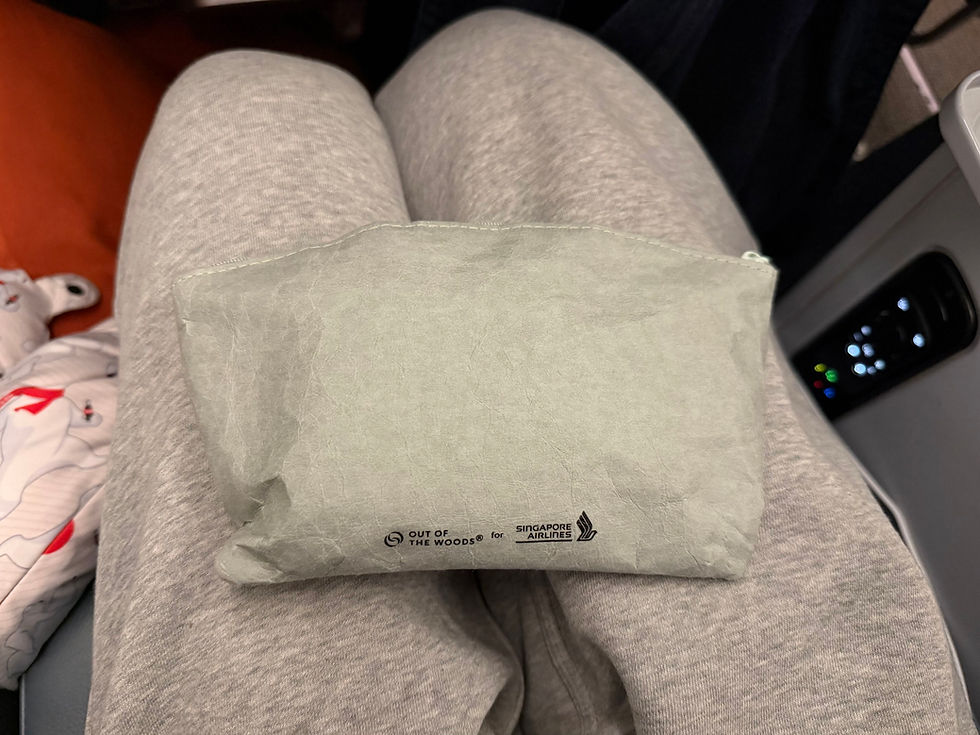
The Premium Economy lavatories on the A350 were practical rather than luxurious. The basic amenities were all present, including antibacterial hand soap and Singapore Airlines-branded moisturizing hand lotion. There was also a foot-operated flap for the waste bin—a small but genuinely useful touch.
The lavatories were not particularly large, but the layout made sense.

More importantly, they remained relatively clean throughout the flight. On an aircraft carrying more than 100 passengers for nearly 19 hours, that does not happen by accident. It reflects the work the crew continues doing behind the scenes while most passengers are sleeping, eating, or watching movies.
Service: Present When Needed, Invisible When Not
Singapore Airlines’ service had a refined sense of restraint.
The cabin crew did not constantly walk through the aisles simply to remind everyone that they were there. During the cruise, appearances were not especially frequent, but when the crew came through, they often carried trays of orange juice and water and proactively offered drinks.
There was always someone available in the rear galley. Whenever I asked for a snack or beverage, the crew provided it without hesitation.
The service did not depend on theatrical gestures or nonstop attention. Instead, it followed a quieter rhythm: do not disturb passengers unnecessarily, but be ready the moment someone needs something.
On a flight this long, that balance is exactly right.
Is It Worth the Money?
After all the talk about seats, congee, champagne, and sleep, we arrive at the most practical question: is this flight actually worth buying?

I booked the outbound and return flights together for approximately $3,400 in total, meaning each direction cost around $1,700.
For Premium Economy on the world’s longest flight during a busy travel period, I consider that a fair—and worthwhile—price.
The strange part is that buying a one-way Premium Economy ticket on its own could cost around $3,100, almost as much as my entire round trip. The pricing logic is difficult to justify beyond the usual explanation of peak-season demand and airline revenue management doing what airline revenue management does best: making no sense to normal people.
My recommendation is straightforward.
At around $1,700 each way as part of a round-trip booking, Premium Economy is excellent value. You receive a spacious seat, nonstop travel, solid service, and the chance to experience the world’s longest commercial flight without paying Business Class prices.
At $3,100 for a one-way ticket, however, the calculation changes.
For roughly the same amount, it may be possible to find one-way Business Class fares from Singapore to New York on airlines such as Emirates, Turkish Airlines, Qatar Airways, or Cathay Pacific. Those itineraries usually involve a connection, so you lose the convenience of flying nonstop—and, of course, the bragging rights that come with completing the world’s longest flight.
Ultimately, the right choice depends on what you are paying for.
Are you simply trying to reach New York or Singapore as comfortably as possible? Or are you buying the experience of this particular route?
Those are two very different products.
Final Verdict: Does 19 Hours Actually Feel That Long?
This was the question people asked me most often after I landed.
Honestly, when you sleep for eight hours, watch two movies, catch a live Premier League match, eat several meals, and sit in a seat that properly supports your body, 19 hours is nowhere near as terrifying as it sounds.
It never feels short. Let us not get carried away.
But it also does not feel unbearable.
The A350-900ULR provides an excellent foundation for the journey. The low-density cabin, oversized Premium Economy seat, deep entertainment library, quieter environment, and solid service all work together to carry you through an entire day in the sky.
The two obvious weak points were the inconsistent food and the Wi-Fi, which largely collapsed during the second half of the flight.
Still, my final verdict could not be clearer: I have already booked the return journey for September, and I will happily fly it again.

For anyone who has ever considered trying the world’s longest flight, Singapore Airlines Premium Economy can absolutely handle the 19-hour mission. Keep your expectations for the food reasonable, download some entertainment before departure, stay hydrated, and settle into the strange pleasure of being temporarily disconnected from the world.
Thanks for reading TAN ZONE and Flying With Chris. I’m Chris, and if you enjoyed this coverage, I recommend checking out more of my work.
![[Flying with Chris] Inaugural Flight-Toronto Island to New York on a Rare Aircraft](https://static.wixstatic.com/media/f35e36_1dd55f70abac4edb88e0d5c9cfb3ee11~mv2.jpg/v1/fill/w_980,h_653,al_c,q_85,usm_0.66_1.00_0.01,enc_avif,quality_auto/f35e36_1dd55f70abac4edb88e0d5c9cfb3ee11~mv2.jpg)
![[Flying with Chris] Cathay Pacific's Soaring Comeback: Why It's the New King of Economy Class in 2025-2026](https://static.wixstatic.com/media/f35e36_d190133b3fb34c0d8c280b99c52942fa~mv2.jpeg/v1/fill/w_980,h_551,al_c,q_85,usm_0.66_1.00_0.01,enc_avif,quality_auto/f35e36_d190133b3fb34c0d8c280b99c52942fa~mv2.jpeg)
Comments