


[Flying with Chris] Cathay Pacific's Soaring Comeback: Why It's the New King of Economy Class in 2025-2026

Updated: Jul 23
I'm simply a regular traveller who, after several flights, has genuinely noticed Cathay Pacific's transformation. Sure, Cathay's had its fair share of turbulence over the past few years — PR nightmares that sent its reputation into a nosedive. But here in 2025, Cathay has clearly pulled itself out of the spin. This year alone, they've snagged Skytrax's "Best Economy Class" and "Best Inflight Entertainment" awards. The "comeback kid" label? Well, they've earned it.

A Strategic Comeback Rooted in Smart Choices
Last month, I flew Cathay round-trip between Beijing and Hong Kong. The experience left quite an impression. Two changes in particular stand out as genuine game-changers:
1️⃣ Hiring Mandarin-speaking cabin crew.

This was the low-hanging fruit for fixing their PR mess, and honestly, it's worked wonders for passengers from the mainland. On my flights, I could chat away in Mandarin without a hitch, and the crew were warm as toast. Naturally, when I switched to Cantonese or English, they handled both like pros.
Two moments really stuck with me. First, I ordered a Coke with ice in English, and the crew member initially said, "We're out of ice at the moment." But lo and behold, ten minutes later she came back with an ice-cold Coke, saying "We have ice now, thank you for waiting." That kind of attention to detail? That's the stuff that makes you feel genuinely looked after.
The second standout moment was on the outbound flight when passengers behind me were being loud and chatty. A quick word with the crew in English, and the situation was sorted in a flash. So yes, English and Cantonese still carry weight. But here's the thing — you won't catch any attitude for speaking Mandarin. At least on the surface, there's no preferential treatment going on.
2️⃣ Laser focus on specific demographics.
Cathay's carved out a crystal-clear niche: premium business travelers, international students, Hong Kong locals, and global transit passengers. Their fleet strategy is equally deliberate — not too much, not too little, just right:
Regional routes rely on the A321neo and A330 for flexibility and frequency
Long-haul and trunk routes are anchored by the A350 and 77W — stable, comfortable, quiet

They've carved out distinct lanes with HK Express: nimble and budget-friendly,
You can tell Cathay hasn't gone on a reckless expansion spree. Instead, they've fine-tuned their route network and flight schedules with surgical precision — a return to business sanity that's genuinely reassuring.
Now, let's talk about the flights themselves. My outbound was CX391 (Beijing–Hong Kong, operated by B-KQM). Return was CX336 (Hong Kong–Beijing, operated by B-LBD).
The Hardware That Makes a Difference
When it comes to economy class, the devil is in the details. Cathay’s choice of aircraft and cabin design shows a clear focus on passenger comfort without tipping into extravagance.
✈️ Aircraft Highlights
Boeing 777-300ER (B-KQM)
The workhorse of Cathay’s long-haul fleet, this aircraft offers a stable, quiet ride with modern amenities.

Airbus A330-300 (B-LBD)
While slightly long in the tooth, the A330 remains a reliable option for medium-haul routes.
💺 Aircraft & Seating
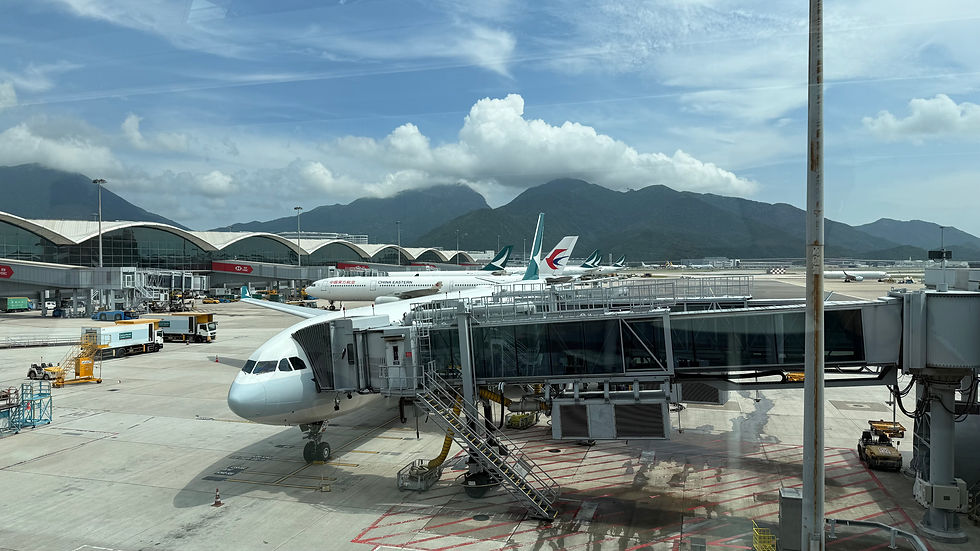
Outbound was a Boeing 777-367ER (B-KQM), return was an A330-343X (B-LBD), both clocking in at 11.3 and 11.4 years respectively. Sure, they're no spring chickens, but they're well-maintained.
Economy seats were roomy and comfortable:
Pitch: 81-83 cm (32-33 inches)
Width: 43-45 cm (17-18 inches)
Recline: 110 degrees
Small Wins That Matter:
Phone holders integrated into seatbacks
Independent cup holders that keep drinks secure
USB and power outlets at every seat
These features add up to a more relaxed and convenient experience.

📺 Cathay's Entertainment System

Movies, music, documentaries — the works. What blew me away was the music library: Chopin nocturnes and études, plus albums from Jacky Cheung, Jay Chou, and other Mandopop heavyweights. The interface supports Simplified Chinese, Traditional Chinese, and English — dead simple to navigate.
Headphones were standard-issue plastic — nothing to write about, just serviceable — but the PTV system itself was top-notch.

That said, the A330's headphone jack was a bit finicky, with sound occasionally distorting or fluctuating in volume. That's a real knock against the experience, especially since that particular aircraft didn't support Bluetooth headphones. I'm keeping my fingers crossed for the A321neo's Bluetooth capability to trickle down to other aircraft types.
Wi-Fi was available throughout, but I didn't bite since I'd already downloaded videos to my iPad beforehand.
🍱 Meal Service: The Soft Product That Elevates Economy
I sampled both the Western-style chicken with mashed potatoes and the Chinese-style beef rice — both hit the spot.

Sides included warm bread, butter, seasonal fruit, and Häagen-Dazs for desert. Portion-wise, it's plenty for a 3-4 hour flight, though it might feel a tad light on ultra-long-haul routes like New York–Hong Kong. My advice? Pack some snacks (though on ultra-long-haul, they do offer instant noodles and egg tarts). Worth noting: metal cutlery adds a touch of class.

I always say details separate an airline from 4-star to 5-star:
Metal cutlery instead of plastic adds a touch of class to meal service.
Warm bread rolls served fresh on board create a comforting dining experience.
Häagen-Dazs, or even ice cream, for dessert is a rare treat in economy in China.
🚘 Ground Experience
Outbound departure was delayed about 20 minutes due to an earlier aircraft issue, then we circled over Hong Kong airspace, landing 41 minutes late in the end. Return flight touched down 18 minutes early. Boarding was orderly, organized by cabin class, and Premium Economy had its own dedicated lane — nice touch.

Baggage claim in Hong Kong was the longest wait I've ever experienced there — about 20+ minutes. Beijing Capital Airport was its usual sluggish self, clocking in at over 30 minutes. But ground staff at both airports were stellar — fluent in Mandarin, Cantonese, or English, patient, and efficient across the board.
🛫 Cathay vs. The Competition?
I've recently flown Air China, Hainan Airlines, ANA, and others. Cathay's overall experience genuinely lives up to that "Best Economy Class" crown.
vs. Air China: Cathay runs circles around them in service, meals, seating, and entertainment. Air China's A330 PTV is practically useless (and don't even get me started on their narrowbodies — just overhead TVs).

vs. ANA/JAL: This is a toss-up depending on your destination. Japanese carriers deliver equally stellar service. For connecting passengers, though, Cathay's Chinese meal options and Mandarin entertainment library definitely hit closer to home.

vs. Hainan Airlines: Also a five-star carrier, Hainan can pleasantly surprise you at times, but overall they haven't quite hit Cathay's level of polish — especially when it comes to cabin quality, PTV, and meal service (not saying Cathay's perfect, just that the overall experience edges ahead).

📈 What About Shareholder Air China?
Back in June, I flew Air China's A330 from Beijing to Hong Kong. The meal? Chicken rice, cold seaweed salad, cantaloupe, and a rock-hard dinner roll fresh from the freezer. Marginally better than Air China's domestic routes, I suppose, but compared to Cathay? Let's just say it's not even in the same ballpark. I'll save the full roast for a dedicated piece — stay tuned for my "Air China Meal Service Autopsy."
As for Air China's other offerings? Not even worth getting into. Their flagship lounge is middling at best, and when you stack it against Cathay's lounges in Hong Kong or even Shanghai, the gap isn't just a stone's throw — it's a canyon. Aside from a handful of A350s, Air China's fleet is almost entirely devoid of air-to-ground Wi-Fi. Take the A330: no phone holder, no cup holder. Across the board — meals, PTV, cabin upkeep — Air China is struggling to keep pace.

🏁 Final Thoughts
Bottom line: today's Cathay is steadily reclaiming that old-school Hong Kong service finesse — thoughtful, meticulous — while also showing it can keep up with the times in product details and route strategy. Whether it's seat design, entertainment, language support, catering, or boarding, they're hitting the benchmarks of a mature, world-class carrier.
That said, they're not without rough edges. Some aircraft are showing their age, headphone quality is ho-hum, and newer aircraft lean toward "cattle class" seat pitch and layout — all areas ripe for improvement.
But looking purely at economy class, Cathay and Taiwan's "Big Three" have opened up a clear lead over China's "Big Three" (Air China, China Eastern, China Southern). That gap isn't just felt during the three-hour flight — it's evident in how they understand passenger needs, invest in service details, and position themselves as airlines.
As a Beijing-based Air China frequent flyer, I'm genuinely concerned about Air China's competitive edge right now. But there's no denying it: Cathay's recent adjustments and optimizations have signaled a true comeback, and they've set a benchmark other carriers would do well to study.
Carving out differentiation among Asian carriers, regaining solid footing in regional markets — Cathay's pivot wasn't early. But so far? It's sure-footed.
Welcome back, Cathay.

![[Flying with Chris] Inaugural Flight-Toronto Island to New York on a Rare Aircraft](https://static.wixstatic.com/media/f35e36_1dd55f70abac4edb88e0d5c9cfb3ee11~mv2.jpg/v1/fill/w_980,h_653,al_c,q_85,usm_0.66_1.00_0.01,enc_avif,quality_auto/f35e36_1dd55f70abac4edb88e0d5c9cfb3ee11~mv2.jpg)
Comments